
Do Schenley Park and Coral Terrace Sellers Owe Capital Gains Tax on Their Home Sale?
For most homeowners in Schenley Park and Coral Terrace, the capital gains home sale Miami calculation comes out to zero — or close to it. The Section 121 exclusion shelters up to $250,000 in gains for single filers and up to $500,000 for married couples filing jointly, provided you have lived in the home as your primary residence for at least two of the past five years. Florida has no state income tax or capital gains tax. Sellers who do not meet the two-year test, who have very large gains, or who are selling investment or inherited property face different rules and should consult a CPA before listing.
By Berenice Elguezabal | July 28, 2026

Given what homes in Schenley Park and Coral Terrace have done over the past decade, the capital gains home sale Miami question comes up in nearly every listing consultation I have. A home purchased in 2010 for $350,000 that is now worth $950,000 represents $600,000 in appreciation — and that number is large enough to make any homeowner wonder what the IRS is going to want when the deal closes.
The good news: for most long-term homeowners in this area, the answer is nothing, or close to it. But the path from “I am selling” to “what do I owe” is specific enough to walk through carefully — because the exceptions matter, and getting this wrong is expensive.
Capital Gains Home Sale Miami: How the Section 121 Exclusion Works
The federal tax code gives homeowners who sell their primary residence a significant break. According to IRS Topic 701, Section 121 of the Internal Revenue Code allows you to exclude up to $250,000 in capital gains from taxable income if you are single, or up to $500,000 if you are married filing jointly.
To qualify, you need to pass two tests:
- Ownership test: You must have owned the home for at least 2 of the past 5 years.
- Use test: You must have used the home as your primary residence for at least 2 of the past 5 years.
The two years do not have to be consecutive, and they do not have to be the most recent two years — they just need to fall within the five-year window before the sale date.
What the Capital Gains Home Sale Miami Math Actually Looks Like
Say you purchased your Schenley Park home in 2015 for $480,000 and you are selling today for $950,000. Your gain is $470,000.
If you are married filing jointly, the $500,000 exclusion covers the entire gain. Your capital gains home sale Miami liability is zero.
If you are single, the $250,000 exclusion covers most of it. Your taxable gain is $220,000. At the long-term capital gains rate, the federal tax on that amount typically falls between 15 and 20 percent for most sellers in this price range — depending on your total income for the year.
Florida’s picture: Florida has no state income tax and no state capital gains tax. Whatever your federal obligation is, nothing additional gets added at the state level — a meaningful advantage over sellers in California, New York, or other high-tax states.
What Adds to Your Gain — and What Reduces It
Your capital gains home sale Miami calculation is not simply sale price minus purchase price. Two adjustments matter significantly.
What Increases Your Adjusted Cost Basis (and Reduces Your Taxable Gain)
- Original purchase price
- Capital improvements: additions, renovations, new roof, HVAC replacement, kitchen and bath remodels, permitted structural changes
- Selling costs: real estate commission, title fees, and closing costs you pay at settlement
What Does NOT Increase Your Basis
- Routine maintenance and repairs — painting, minor fixes, landscaping upkeep
- Costs you have already deducted elsewhere on your taxes
Keeping records of capital improvements is especially important for Schenley Park and Coral Terrace sellers who have done significant work on their homes — permitted additions, kitchen and bath renovations, new roofs, or HVAC replacements. Every documented improvement increases your adjusted basis and directly reduces the capital gains home sale Miami amount subject to tax.
When You Might Not Qualify for the Full Exclusion
You Have Not Lived There for Two Years
If you are selling a property you purchased recently or converted from a rental, you may not pass the use test. A partial exclusion is available for certain qualifying circumstances — job relocation, health reasons, or unforeseen events — but the full exclusion requires the two-year primary residency.
Your Gain Exceeds the Exclusion
If you are a long-term owner with a very large gain — common in Schenley Park given appreciation since the early 2000s — the portion above $500,000 (married) or $250,000 (single) is taxable. At current long-term capital gains rates, most sellers in this income range face a 15 to 20 percent federal rate on the excess, plus the 3.8 percent net investment income tax for higher earners.
You Have Rented the Home
If you rented the home for any period, the math becomes more complex. Depreciation taken during the rental period is recaptured at a different tax rate. This is a conversation to have with a CPA before you list — not after you are under contract.
You Are Selling an Inherited Property
Inherited homes receive a stepped-up basis — the property’s fair market value at the date of death, not the original purchase price. This often significantly reduces or eliminates the taxable gain, but the specific circumstances determine the outcome.
You Are Selling Investment Property
If the home was never your primary residence, Section 121 does not apply. Investment properties may qualify for 1031 exchange treatment instead, which allows deferral of capital gains tax through reinvestment in another qualifying property.
What This Means for Schenley Park and Coral Terrace Sellers Specifically
The capital gains home sale Miami question looks different in Schenley Park and Coral Terrace than in most Miami-Dade neighborhoods — because appreciation here has been unusually significant over the past two decades. Homes purchased in the early 2000s for $250,000 to $350,000 are now trading at $850,000 to well over a million. That scale of appreciation puts many long-term owners close to or above the exclusion threshold, which is exactly why running the numbers before you list matters here more than in neighborhoods with slower appreciation curves.
The practical takeaway for most Schenley Park sellers: if you have lived in your home as your primary residence for at least two of the last five years, have not rented it, and your gain does not substantially exceed the exclusion, your federal exposure is likely minimal or zero. The bigger financial planning conversations for long-term owners here are typically Save Our Homes portability — which transfers your accumulated tax benefit to your next Florida homestead — and basis documentation, where undocumented improvements can quietly cost sellers at tax time.
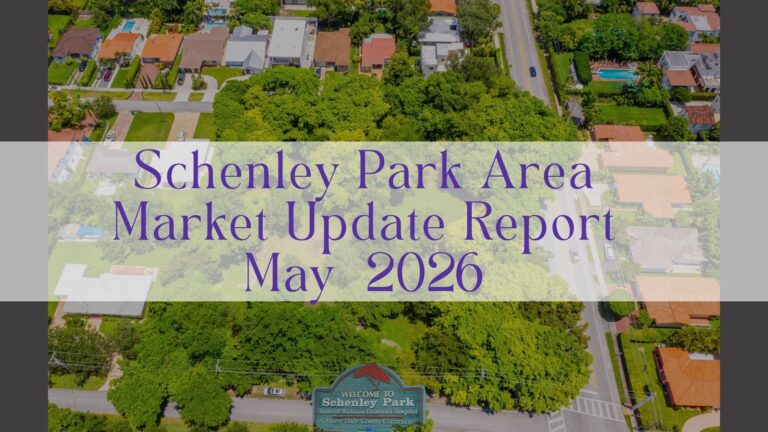
The Schenley Park Market Report tracks current median sale prices every month — a useful starting point for estimating your gain before any CPA conversation.
What to Do Before You List
Capital gains home sale Miami planning works best when it starts before you list, not after you are under contract. Once you are in escrow, the clock is running and your options narrow. If your gain is potentially above the exclusion threshold, a CPA can help you look at basis recovery, timing strategies, whether a 1031 exchange applies if you are moving into investment property, and charitable strategies for appreciated assets.
I walk sellers through the full financial picture of a sale as part of every listing consultation — because the tax side is part of that picture, and it is easier to address when there is still time to address it. Get a free home valuation to start with what your home is worth in today’s market, then use that number to begin estimating your gain and planning accordingly.
Frequently Asked Questions About Capital Gains Home Sale Miami
Do I have to pay capital gains when selling my home in Miami?
Florida has no state income tax or capital gains tax, so there is no state tax on your home sale proceeds. Federal capital gains tax may apply, but most primary homeowners qualify for the Section 121 exclusion — up to $250,000 for single filers and $500,000 for married couples filing jointly. For most long-term Schenley Park and Coral Terrace sellers, the capital gains home sale Miami result is zero federal liability.
What is the two-year rule for capital gains on a home sale?
To qualify for the Section 121 primary residence exclusion, you must have owned and used the home as your primary residence for at least 2 of the 5 years preceding the sale. The two years do not have to be consecutive — they just need to fall within that five-year window. This is the core test that determines your capital gains home sale Miami exposure.
What counts as a capital improvement for tax purposes?
Capital improvements are permanent additions or upgrades that add value to the property or extend its useful life — kitchen and bath remodels, room additions, a new roof, HVAC replacement, and permitted structural changes. Routine maintenance and repairs do not count. Every documented improvement increases your adjusted basis and reduces the capital gains home sale Miami amount subject to federal tax.
Does the capital gains exclusion apply to rental or investment properties?
No. The Section 121 exclusion applies only to your primary residence. Investment and rental properties are subject to different rules, including depreciation recapture and potentially 1031 exchange treatment. If your Schenley Park or Coral Terrace home was rented for any period, consult a CPA before listing to understand how that affects your situation.
Should I talk to a CPA before selling my Schenley Park or Coral Terrace home?
Yes — if your gain is large enough to potentially exceed the exclusion, if you have rented the home at any point, or if you are planning to use the proceeds in a way with tax implications. Capital gains home sale Miami planning works best before you list, not after you are under contract and the clock is running.
Ready to Talk Through the Full Financial Picture Before You List?
Understanding your capital gains home sale Miami exposure is one piece of the pre-listing conversation — alongside your net proceeds, your mortgage payoff, and your Save Our Homes portability if you are staying in Florida. Getting all of those numbers in front of you before you list is what makes every decision that follows clearer.
- Free instant home valuation: Request your home value
- 📞 305-301-3290
- 📧 Bere@BereHomes.com
The Schenley Park Market Report is updated every month with the latest sales data and pricing trends — a useful starting point for estimating your gain before any CPA conversation.
Prefer I reach out?
Leave your details and I’ll get back to you the same business day.
Rather pick a time? Book a 15-minute call

Berenice Elguezabal
REALTOR® · Coldwell Banker Realty · Since 2001 · FL Lic. SL0695500
★ Int’l President’s Circle 2025 · Top 4% Nationwide
$150M+ career sales · 250+ closed · 7 sold in Schenley Park