Who Has to Sign Off to Sell a House During a Divorce in Florida?
When selling house during divorce Florida, both spouses must sign the sales contract if both are on the deed — one spouse cannot unilaterally list or sell a marital home in Miami-Dade. If the home is titled as tenants by the entirety, which is the default for married couples in Florida, a court generally cannot force a sale until the divorce is finalized. This means mutual agreement is the only path forward before the decree is entered.
By Berenice Elguezabal | August 12, 2026
If you are going through a divorce and you and your spouse own a home together in Schenley Park, Coral Terrace, or anywhere in unincorporated Miami-Dade, you are probably asking two things at once: what happens to the house, and how do we get through this without it turning into a second fight on top of the first one.
Selling house during divorce Florida is rarely just a real estate transaction — it is usually the biggest financial decision of the divorce, tangled up with timing, emotions, and two people who need to agree on something while everything else feels unresolved. Here is what actually happens, and what you need to know before you list.
Selling House During Divorce Florida: What the Law Actually Requires
Florida divides marital property under Florida Statute 61.075, using what is called equitable distribution. That does not mean an automatic 50/50 split. Courts start from that presumption, then adjust based on each spouse’s financial circumstances, contributions to the marriage, and other factors specific to the situation.
A few things that matter for the house specifically:
- Both names on the deed means both signatures are required. You cannot list or accept an offer without your spouse’s written consent, even if you are the one who wants to move forward.
- Ownership structure matters. Most married couples in Florida hold title as tenants by the entirety. Under this structure, a court typically cannot order a forced sale before the divorce is finalized — so if you and your spouse disagree about selling now, mutual agreement is usually the only route until the decree is entered.
- After finalization, a partition action becomes available. If you still cannot agree once the divorce is final, either party can petition the court to force a sale — sometimes through a public auction, which tends to bring a lower price than a private market sale.
Why Timing the Sale Matters More Than People Expect
Here is a detail that surprises many people going through the selling house during divorce Florida process: there is a real tax argument for selling before the divorce is finalized, not after.
Married couples filing jointly can exclude up to $500,000 in capital gains on the sale of a primary residence. Once the divorce is final, that exclusion drops to $250,000 per person. On a Schenley Park or Coral Terrace home that has appreciated significantly over the past several years — which describes most properties in this market — that difference can mean a meaningfully larger tax bill if you wait.
Timelines vary significantly from one divorce to the next. Some settlement agreements give sellers as little as 30 days to list. Others allow a year or more. If your attorney is negotiating the terms of the divorce and the house is part of that conversation, it is worth raising the timing question early — not after the settlement is signed.
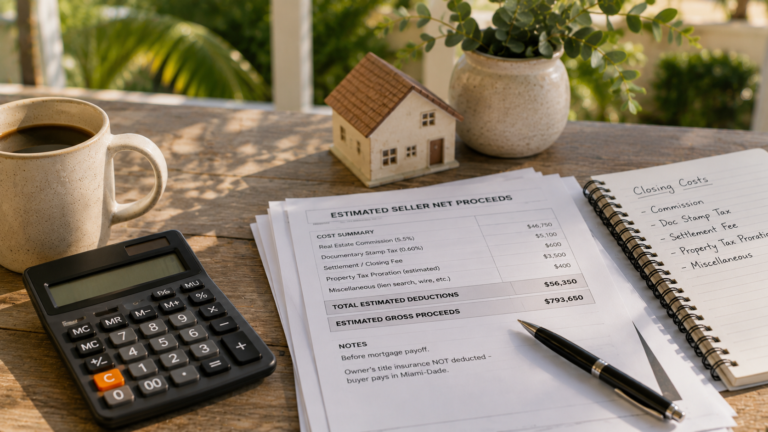
Net proceeds from the sale are typically held in escrow by the title company until you and your spouse reach an agreement, or until the court directs how they are distributed. That is standard practice, not a sign that anything has gone wrong. For additional context on what those net proceeds look like after all costs, see the companion post on [LINK: seller net proceeds blog].
What the Process Actually Looks Like
Selling house during divorce Florida follows the same mechanical steps as any other Miami-Dade sale — pricing, listing, showings, offer, inspection, closing — but with one added layer: everything involving the house needs two signatures and, ideally, one coordinated strategy.
A few things that make the process go more smoothly:
- Get on the same page about price before you list. Disagreements about listing price are one of the most common ways a divorce sale stalls. An outside, data-backed opinion of value — not either spouse’s number — tends to defuse this quickly.
- Decide who handles what during the sale. Showings, repair negotiations, and buyer communication go more smoothly when one person is the designated point of contact, even if both spouses are involved in every decision.
- Loop in your attorney before you accept an offer, not after. Your divorce attorney and your real estate agent should be in communication, especially around how proceeds get held and disbursed at closing.
- Understand what you are required to disclose. The Florida Seller’s Property Disclosure applies here just like any sale — and if your home is on a septic system, common throughout the Schenley Park area, or in a flood zone, those disclosures apply regardless of what is happening in your personal life.
Selling Before or After the Decree — What Actually Makes Sense
There is no universal right answer, but a few patterns hold up consistently in the selling house during divorce Florida context:
- If you and your spouse agree the house needs to sell, doing it before the decree is usually cleaner. It converts the largest shared asset into cash, removes the shared mortgage liability, and preserves the larger capital gains exclusion.
- If you disagree, and the home is titled as tenants by the entirety, you are likely waiting until the divorce is final — unless one spouse is willing to buy out the other’s share.
- If a buyout is on the table, get an accurate value first. Buyouts based on a guess, an old appraisal, or a Zestimate tend to shortchange one spouse. A current, local market analysis is the right starting point for that conversation.
This is not legal advice, and every divorce has its own terms, timeline, and court involvement. Your family law attorney should always be guiding the legal and financial strategy — the role of a real estate agent in this situation is making sure the real estate part is handled clearly, accurately, and without adding more stress to an already hard year.
What This Means for Schenley Park and Coral Terrace Homeowners Specifically
The selling house during divorce Florida process looks somewhat different in Schenley Park and Coral Terrace than it does in a more standard neighborhood — and the reason is the same three-buyer-pool dynamic that shapes every sale in 33155. A retail buyer, an investor, and a builder each price a Schenley Park property using completely different math. In a divorce sale where both parties need to agree on a price and a direction, getting that analysis wrong — or pricing the home for the wrong buyer type — can stall the process at exactly the moment when momentum matters most.
The pressure of a divorce timeline should not lead to a rushed pricing decision. Whether the right path is a retail sale, an investor offer, or a builder’s teardown price, that determination should come from current comparable sales specific to this market — not a Zestimate or what either spouse thinks the home is worth based on what a neighbor got two years ago.
If your home is one of the many in this pocket of 33155 on septic rather than city sewer, or if you are weighing whether a builder’s teardown offer makes more sense than a traditional retail sale, those are conversations worth having with someone who tracks this specific market every month. The Schenley Park Market Report is where the current sales data lives — updated monthly with the actual pricing context behind decisions like this one.
Frequently Asked Questions About Selling House During Divorce Florida
Can one spouse sell the house without the other’s consent in Florida?
No. When selling house during divorce Florida, if both spouses are on the deed, both must sign the sales contract. One spouse cannot list, market, or accept an offer on a marital home without the other’s written consent — even during active divorce proceedings.
Can a Florida court force the sale of the marital home before the divorce is finalized?
Generally no, if the home is titled as tenants by the entirety, which is the default for married couples in Florida. Courts typically cannot order a forced sale of entireties property before the divorce is legally finalized, which is why mutual agreement is so important during the selling house during divorce Florida process.
Is it better to sell before or after the divorce is final in Florida?
There is a meaningful tax incentive to sell before finalization: married couples filing jointly can exclude up to $500,000 in capital gains from the sale of a primary residence, compared to $250,000 per person after the divorce is final. Talk with your attorney and a CPA about how this applies to your specific circumstances and the appreciation on your Schenley Park or Coral Terrace home.
What happens to the sale proceeds during a divorce?
Proceeds are typically held in escrow by the title company until you and your spouse reach an agreement on distribution, or until the court provides direction. This is standard procedure in the selling house during divorce Florida process and protects both parties.
Do I still need to disclose septic and flood zone information if I am selling during a divorce?
Yes. Standard Florida disclosure requirements — including the Seller’s Property Disclosure, septic tank disclosure, and flood zone disclosure — apply regardless of the circumstances driving the sale. In Schenley Park and Coral Terrace, where most homes are on septic rather than city sewer, this disclosure is particularly relevant.
Ready to Get a Clear, Accurate Number Before You Make Any Decisions?
Selling house during divorce Florida is rarely just about the real estate — but the real estate part does not have to be the hardest piece. Getting an accurate, unbiased value for what your Schenley Park or Coral Terrace home is worth is usually the first step toward a clear decision, whether that is listing, buying out your spouse, or agreeing on a timeline with your attorneys.
- Free, no-pressure home valuation: Request your home value
- 📞 305-301-3290
- 📧 Bere@BereHomes.com
The Schenley Park Market Report is updated every month with current sales data — useful context for understanding what your home is realistically worth in today’s market before any decisions are made.
Prefer I reach out?
Leave your details and I’ll get back to you the same business day.
Rather pick a time? Book a 15-minute call

Berenice Elguezabal
REALTOR® · Coldwell Banker Realty · Since 2001 · FL Lic. SL0695500
★ Int’l President’s Circle 2025 · Top 4% Nationwide
$150M+ career sales · 250+ closed · 7 sold in Schenley Park