Homestead Portability in Florida: The $500,000 Tax Benefit Schenley Park Sellers Can’t Afford to Lose
If you’ve owned your Schenley Park or Coral Terrace home for more than five years, there’s a very good chance you’re sitting on a tax benefit most sellers don’t fully understand — and many accidentally leave behind when they sell.
It’s called homestead portability, and it could be worth hundreds of thousands of dollars over the life of your next home.
Here’s what it is, how it works, and — most importantly — what you have to do to keep it when you sell.
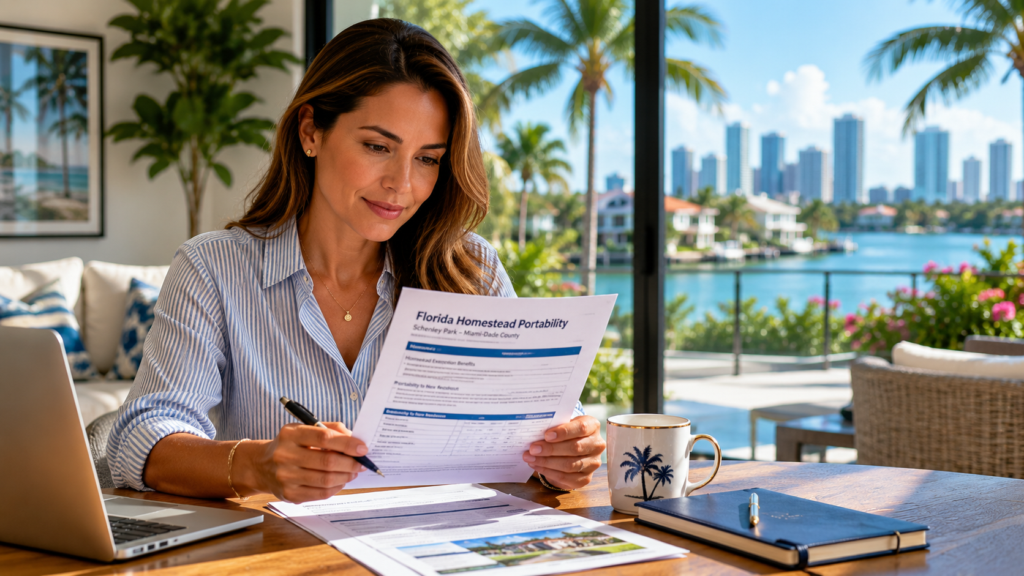
The Save Our Homes Cap: Why Your Tax Bill Is Lower Than It Should Be
Florida’s Save Our Homes amendment limits how much the assessed value of a homesteaded property can increase each year — currently capped at 3% or the rate of inflation, whichever is lower. For most longtime homeowners in Miami-Dade, this means the assessed value of your home is dramatically lower than what it would actually sell for today.
Here’s a real-world example: if you bought your Schenley Park home in 2005 for $450,000, your assessed value today — after 21 years of capped increases — might be around $520,000.
But your home’s market value might be $950,000. That $430,000 difference is your Homestead Assessment Difference (HAD) — and it’s the reason your property tax bill is far lower than your neighbor who bought recently at market value.
When you sell and buy a new home in Florida, without portability you’d lose that benefit entirely. Your new home would be assessed at market value, and your tax bill would jump significantly. Portability lets you take up to $500,000 of that HAD with you.
How Much Can You Actually Transfer?
The formula used by the Miami-Dade Property Appraiser is:
- Portability benefit = your HAD (up to $500,000 maximum)
- The amount you can apply depends on the relationship between your new home’s value and your old home’s value
- If you’re moving to a home of equal or greater value, you can transfer the full HAD (up to $500,000). If you’re downsizing, the benefit is prorated based on the ratio of the new home’smarket value to the old home’s market value.
- For many longtime Schenley Park sellers, this is a five-figure benefit — sometimes more — in annual tax savings on their next home. It compounds over time. The earlier you start the process and understand what you have, the better equipped you are to factor this into your move.
How Portability Works in Plain Numbers
The rule changes depending on whether your next home costs more or less than the one you are selling. This is the part most sellers get wrong.
If your next home is worth the same or more
You transfer the full dollar amount of your benefit, up to $500,000. Say your current home has a market value of $900,000 and an assessed value of $400,000. Your Save Our Homes benefit is $500,000, and it moves with you to the new property.
If your next home is worth less
You transfer the same percentage of protection rather than a flat dollar amount. If your benefit represents 55% of your current home’s value, the new home’s assessed value starts 55% below its market value, up to the same $500,000 ceiling. If you are downsizing in Schenley Park, this is the calculation that decides how much of your tax advantage survives the move.
Either way, the saving compounds for as long as you own the next home. It is not a one-year discount.
The Deadline That Cannot Be Missed
This is the part that catches sellers off guard. To claim portability on your new home, you must:
- Establish homestead exemption on your new property — and file the portability application — by March 1 of the year following your move
- Complete the move within three assessment years of abandoning the homestead on your sold property That means if you sell your Schenley Park home in July 2026 and move into a new Florida home before December 31, 2026, you must file for both homestead exemption and portability on the new property by March 1, 2027. Miss that deadline and you cannot claim portability for that tax year.
The good news: the Miami-Dade Property Appraiser offers online filing at miamidade.gov/pa, and the application is free. You can also file in person at one of their offices. The process is straightforward once you know it exists and know you’re on a deadline.
The forms, and the clock you may be misreading
There are two applications, and they are separate: Form DR-501 for the homestead exemption on the new property, and Form DR-501T for the portability transfer itself. Filing one without the other is the most common way this benefit gets lost.
The detail that catches people: the three-year window starts on January 1 of the year you sold, not on your closing date. Close in late December and your window can shrink to barely two years. If you are planning a sale near year end, that timing is worth a conversation before you list, not after.
The Miami-Dade Property Appraiser publishes a portability calculator on its website. Running your own numbers there before you list takes a few minutes and occasionally changes the plan entirely.
Upcoming Change: The $500,000 Cap May Be Gone by 2027
Florida voters will consider a constitutional amendment in November 2026 (HJR 211) that would eliminate the $500,000 cap on portability entirely. If it passes, homeowners with an HAD of more than $500,000 — increasingly common in Miami-Dade, where values have risen sharply over the past decade — would be able to transfer their full benefit, no matter how large.
This is worth paying attention to if you’re a longtime 33155 homeowner considering whether to sell in 2026 or wait. The November 2026 vote could materially change the financial picture for your next purchase. It’s one of several timing factors worth discussing as part of your overall selling strategy.
What This Means Specifically in Schenley Park and Coral Terrace
Schenley Park and Coral Terrace are among the most tenured pockets in Miami-Dade. It is common here to meet owners who have been in the same house 20, 25, or 30 years, which means Save Our Homes benefits in 33155 are often large — in plenty of cases large enough to hit the $500,000 ceiling.
That is why the timing of a sale in this neighborhood is not only a real estate decision. When you sell, what you buy next, and how you sequence the two all change what you keep. Sellers who work that out before listing end up in a materially better position than the ones who find out afterward.
What Sellers Need to Do Before They List
Portability doesn’t require action before you sell — but it requires awareness before you sell, so you don’t make decisions that inadvertently forfeit the benefit.
Specifically:
- Understand your HAD before you price. Your assessed value and market value are different numbers. Knowing the gap helps you understand not just your tax benefit but also your net proceeds (your assessed value feeds into your property tax proration at closing — a cost that’s easy to underestimate on a mid-year sale).
- Don’t let the three-year clock run. If you sell and then rent for two years before buying again in Florida, you may still be within the window. But the window closes. Know the timeline.
- File by March 1 on the new property. This is the deadline that most people miss. Your real estate agent on the buy side should remind you — but don’t rely on anyone else to track this.
Your net proceeds at closing account for a tax proration based on your assessed value.
Understanding both your assessed value and your SOH benefit helps you model what you’ll owe at closing and what you’ll carry into your next purchase.
Two Other Numbers That Move at Closing
Portability is one piece of the tax picture. Two others come up in almost every conversation.
Capital gains. Florida has no state income tax, so there is no state capital gains tax on your sale. At the federal level, a primary residence you have lived in for two of the last five years qualifies for an exclusion of up to $250,000 single or $500,000 married. For many long-held homes here that covers most of the gain, but rentals, home offices and inherited property change the math. The details are in the capital gains guide for Schenley Park and Coral Terrace sellers.
Documentary stamp tax. In Miami-Dade the seller customarily pays doc stamps on the deed, and it is one of the larger line items on the closing statement. It is broken down alongside the rest in what sellers actually walk away with.
The homestead exemption itself works differently from portability and is worth understanding on its own: see the 2026 homestead exemption guide.
Frequently Asked Questions
What is the Save Our Homes benefit and how does it affect my property taxes?
Florida’s Save Our Homes amendment caps annual increases in a homesteaded property’s assessed value at 3% or the rate of inflation, whichever is lower. Over time, this creates a gap between your assessed value (what you’re taxed on) and your market value (what your home is actually worth). For longtime Miami-Dade homeowners, this gap can be substantial — often $200,000 to $500,000 or more — resulting in a significantly lower tax bill than a neighbor who bought recently at today’s prices.
How much of my Save Our Homes benefit can I transfer to my next home?
You can transfer up to $500,000 of your Homestead Assessment Difference (the gap between your market value and assessed value) to a new Florida homestead. If you’re moving to a home of equal or greater value, you can transfer the full amount up to $500,000. If you’re downsizing, the benefit is prorated. A constitutional amendment on the November 2026 ballot would eliminate the $500,000 cap entirely if it passes.
When must I apply for portability in Miami-Dade?
You must file the portability application — along with your homestead exemption application — on the new property by March 1 of the year following your move. Filing is free and can be done online at miamidade.gov/pa or in person at the Miami-Dade Property Appraiser’s office. You must also complete the move within three assessment years of abandoning homestead on the sold property.
Does portability transfer automatically when I sell?
No. Portability is not automatic. You must actively file an application on your new property by the March 1 deadline. The Miami-Dade Property Appraiser does not notify you or file on your behalf. Sellers who move without filing on time forfeit the benefit for that tax year.
How do I find out what my current Homestead Assessment Difference is?
You can look up your current assessed value and market value on the Miami-Dade Property Appraiser’s website at miamidadepa.gov. The difference between the two is your HAD. Your property tax bill also shows both figures. If you’re unsure, the Property Appraiser’s office can be reached at 305-375-4125 — they can walk you through your specific numbers.
Homestead portability is one of the most financially significant — and most overlooked — parts of selling a home in Miami-Dade. For Schenley Park homeowners who’ve been in their homes for ten, fifteen, twenty years or more, it’s not a small number. It’s a benefit that follows you and reduces your tax bill on your next home for as long as you own it in Florida.
I walk every seller I work with through the full financial picture of their move — what they’ll net at closing, what they’ll save on the next purchase, and what deadlines they can’t afford to miss.
If you want to understand what your Schenley Park or Coral Terrace home is worth today — and how your full financial picture looks before and after the sale — let’s start with a free home valuation. Get your free home valuation →
Prefer I reach out?
Leave your details and I’ll get back to you the same business day.
Rather pick a time? Book a 15-minute call

Berenice Elguezabal
REALTOR® · Coldwell Banker Realty · Since 2001 · FL Lic. SL0695500
★ Int’l President’s Circle 2025 · Top 4% Nationwide
$150M+ career sales · 250+ closed · 7 sold in Schenley Park