Can a Builder Legally Put More Than One Home on Your Schenley Park Lot?
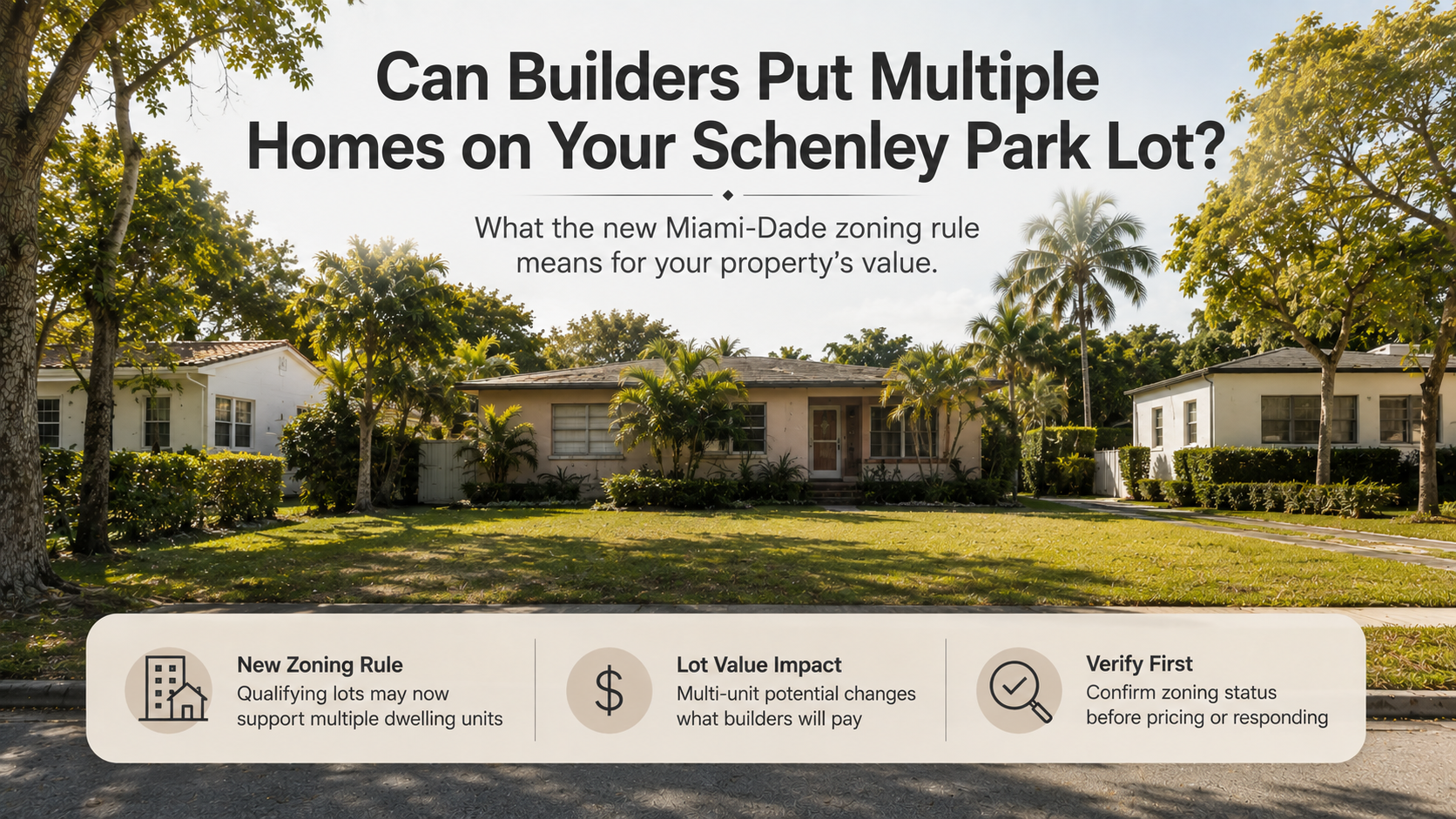
The multiple units one lot Miami-Dade question has a new answer for many properties in unincorporated Miami-Dade County — which includes Schenley Park, Coral Terrace, Coral Villas, and West Miami. Under the county’s Workforce Housing Development Program (Article XII-A of the Miami-Dade County Code), qualifying single-family lots can now support more than one dwelling unit, with the number determined by lot size and a density formula, not just a single teardown-and-rebuild. That changes what your lot may be worth to a builder, and it is worth understanding before you price your home or respond to an offer.
By Berenice Elguezabal | August 27, 2026
For the last few years, the story in Schenley Park and Coral Terrace has been consistent: a builder buys an older home, tears it down, and puts up one new house that sells for up to $2.5 million. That is still happening. But a newer piece of Miami-Dade zoning policy is starting to change the math for some lots, and I am fielding more questions about it every month.
What Actually Changed in Miami-Dade Zoning
Schenley Park, Coral Terrace, Coral Villas, and West Miami all sit in unincorporated Miami-Dade County — meaning they fall under county jurisdiction rather than a city government. That distinction matters more than usual right now.
Under Miami-Dade’s Workforce Housing Development Program, the multiple units one lot Miami-Dade framework gives owners of qualifying single-family (RU-1) lots in unincorporated areas the right to build more than one housing unit on their property, with the exact number tied to lot size and a density calculation in the county code. In practice, that means a lot that used to support one new single-family home under the old teardown model can, in some cases, now support a duplex or multiple units instead.
According to Miami-Dade Zoning and Development Services, this program is a separate policy from the county’s accessory dwelling unit (ADU) ordinance, which has been on the books since 2023. The ADU rule lets an owner-occupant add one detached or attached accessory unit to an existing home on lots as small as 5,000 square feet — but requires the owner to live on the property. The Workforce Housing Development Program is broader: it does not require owner-occupancy, which is exactly why it is attracting builder and investor attention. Florida’s Live Local Act continues to expand at the state level as well, adding a second layer of pressure toward higher-density redevelopment on qualifying parcels.
Not every neighbor is thrilled about it. Some unincorporated Miami-Dade communities have pushed back publicly, citing concerns about parking, traffic, and out-of-state investors converting single-family homes to multi-unit rentals with limited local oversight. That pushback has not reversed the rule, but it is a reminder that this is an evolving area of county policy, not a settled one.
Multiple Units One Lot Miami-Dade: What This Means for Your Lot’s Value
I have been walking sellers through three buyer types for a while now: the retail buyer who wants a move-in-ready home, the investor or flipper who renovates and resells, and the builder who tears down and rebuilds one new house. The multiple units one lot Miami-Dade program effectively adds a fourth lens to that comparison — the builder who is evaluating your lot for its multi-unit potential, not just its single-home potential.
Here is why that matters for pricing. A builder who can only put one new house on a lot has a ceiling on what they can pay and still profit. A builder who can legally put two or three units on the same lot has a different — often higher — ceiling, because they are spreading their land cost across more sellable square footage. In theory, that competition should work in your favor.
In practice, it only works in your favor if your specific lot actually qualifies. A 7,500-square-foot interior lot in Coral Terrace that would have been priced purely as single-home teardown land in the high $600s might justify a stronger offer from a builder who has confirmed it can support multiple units under the density formula — but only if the numbers actually pencil out for setbacks, parking, and unit count. A vague verbal offer that references “the new zoning rule” without showing the math behind it is not worth more than a traditional teardown offer. It is worth exactly what the builder can prove.
Do Not Assume — Verify First
Before you price a listing around multiple units one lot Miami-Dade potential, or take a builder’s word for it, confirm three things:
- Your property’s exact zoning designation and unincorporated status with Miami-Dade’s Zoning and Development Services department. Not every parcel that looks unincorporated actually is, and municipal boundaries can be easy to misjudge from the street.
- A real density and unit-yield estimate from an architect or land planner familiar with the Workforce Housing Development Program — not a builder’s back-of-napkin number.
- How the offer compares to a traditional retail sale, a straightforward single-home teardown offer, and a multi-unit-adjusted offer, side by side. Every path has different timelines, different certainty, and a different net number.
What This Means for Schenley Park and Coral Terrace Sellers Specifically
The multiple units one lot Miami-Dade conversation has a specific relevance in Schenley Park and Coral Terrace because of how active the builder and investor market already is in 33155. Lots here have been trading at $650,000 and above as pure teardown land, and new construction on those same lots has reached $2.5 million. The Workforce Housing Development Program does not change those fundamentals — but it does change the ceiling for some lots, and the sellers most likely to benefit are those with larger-than-average parcels in confirmed unincorporated territory.
The sellers most at risk of being taken advantage of are those who accept a builder’s offer at face value because it references “multi-unit potential” without independently verifying whether that potential actually exists for their specific parcel — and what it is actually worth if it does. A lot that qualifies under the program is worth more to the right builder. The same lot, sold to the wrong buyer at the wrong price because the seller never confirmed the details, is a missed opportunity.
This is exactly the kind of layered decision worth walking through before you set a price — comparing what a retail buyer, an investor, a single-home builder, and now a multi-unit builder would each actually pay for your specific lot. The Schenley Park Market Report is updated monthly with current sales data across all buyer types, and is a useful starting point for understanding where your lot sits before any builder conversation happens.
If you are weighing a sale against holding the property as a rental, that math is covered in Rental Property vs. Sale in 2026. And if a cash or investor buyer has already approached you directly referencing this zoning change, comparing their number against a traditional MLS listing is broken down in Cash Offer vs. MLS Listing for Miami Investment Property.
What to Do Before You List or Respond to a Builder’s Offer
If you are getting calls or letters referencing higher offers because of “new zoning” or “multi-unit potential,” take these steps before you respond:
- Confirm your parcel’s zoning and unincorporated status directly with the county — do not rely on a buyer’s summary of it.
- Ask any builder making a multiple units one lot Miami-Dade offer to share the density and unit-yield calculation behind their number.
- Get an independent read on your lot’s actual potential from a professional who is not the one trying to buy it from you.
- Compare that number against current sale data for your block — the Schenley Park Market Report is updated monthly and is a good starting point for what is actually closing nearby.
- Talk through your specific situation before you sign anything. A zoning rule that theoretically increases your lot’s value does not help you unless the offer in front of you reflects it accurately.
The bottom line: this zoning shift does not automatically mean your Schenley Park or Coral Terrace lot is worth more overnight. It does mean the buyer pool has gotten more interesting, and any offer that leans on “the new rule” deserves a closer look before you price around it or accept it.
Frequently Asked Questions About Multiple Units One Lot Miami-Dade
Does the new zoning rule apply to every lot in Schenley Park or Coral Terrace?
No. The multiple units one lot Miami-Dade program applies specifically to qualifying single-family lots in unincorporated Miami-Dade County that meet the size and density requirements under the Workforce Housing Development Program. Confirm your parcel’s exact zoning designation and unincorporated status with Miami-Dade Zoning and Development Services before assuming it qualifies.
Is this the same thing as an accessory dwelling unit (ADU)?
No. Miami-Dade’s ADU ordinance lets an owner-occupant add a single accessory unit to their existing home and requires the owner to live on the property. The Workforce Housing Development Program is a separate county program that can allow a qualifying lot to be redeveloped into a duplex or multiple units and does not require owner-occupancy — which is why it attracts builder and investor interest.
Will selling to a multi-unit builder increase my property taxes before closing?
No. Your property taxes reflect the property’s current use and assessed value under your ownership. Any reassessment tied to redevelopment happens after the sale, under the new owner. For specifics tied to your situation, check with the Miami-Dade Property Appraiser’s office or your CPA.
How do I know if a builder’s offer actually reflects my lot’s real multiple units one lot Miami-Dade potential?
Ask the builder to share the density and unit-yield calculation behind their number, then compare it against an independent estimate from an architect, land planner, or your agent. An offer without verifiable math behind it is not a number you should price against or accept based on face value alone.
Should I wait to sell until this zoning situation settles further?
That depends on your timeline, whether your specific lot qualifies, and how much builder interest is already active on your block. This is exactly the kind of question worth walking through with someone tracking the Schenley Park and Coral Terrace market closely, rather than guessing based on a single offer or headline.
Ready to Find Out What Your Lot Is Actually Worth in Today’s Market?
Your specific number depends on your lot’s size, its zoning status, and how builders are currently pricing multiple units one lot Miami-Dade potential on your block — that is where a local market analysis comes in, not a builder’s verbal offer referencing “the new rule.”
- Free instant home valuation: Request your home value
- 📞 305-301-3290
- 📧 Bere@BereHomes.com
Prefer I reach out?
Leave your details and I’ll get back to you the same business day.
Rather pick a time? Book a 15-minute call

Berenice Elguezabal
REALTOR® · Coldwell Banker Realty · Since 2001 · FL Lic. SL0695500
★ Int’l President’s Circle 2025 · Top 4% Nationwide
$150M+ career sales · 250+ closed · 7 sold in Schenley Park